Ask ChatGPT, Perplexity, or Google AI Overviews in Traditional Chinese which SaaS provider in Taipei is worth considering or whether a particular tool is worth buying. The answer may cite a Dcard thread, PTT replies, a Mobile01 review, a Chinese Wikipedia entry, local news, or public data from .gov.tw instead of the brand's official site. If those sources never mention you, publishing more on your own site may still leave the brand absent from the answer.
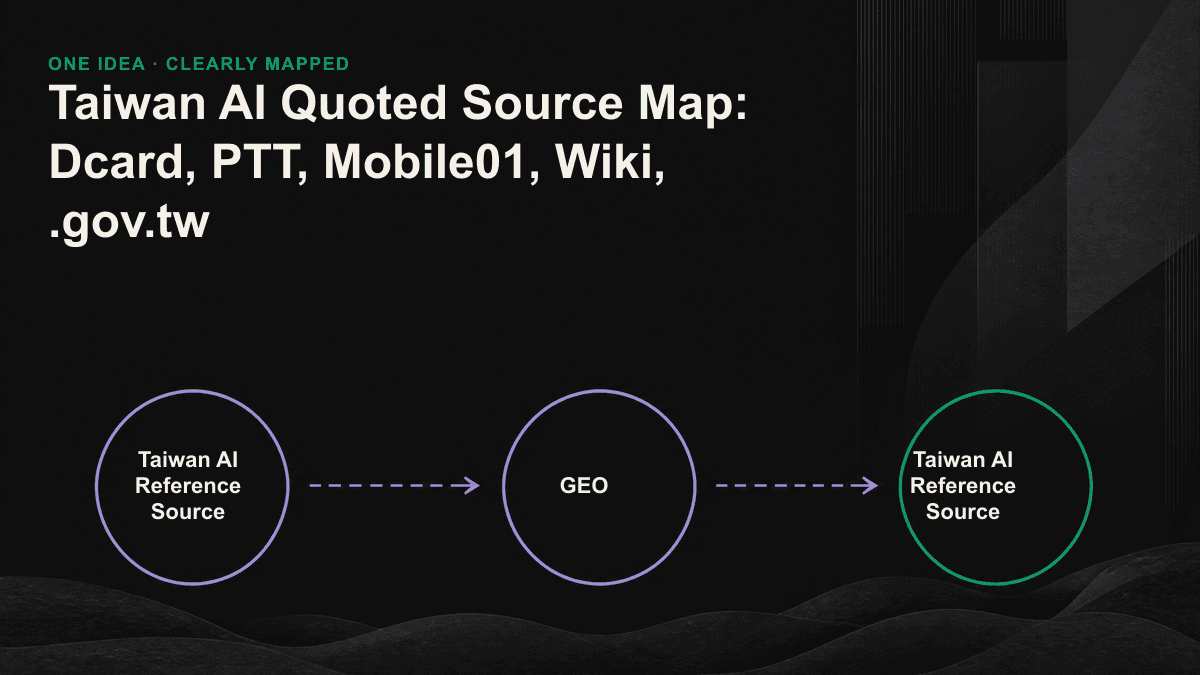
These six source types recur in Traditional Chinese AI answers for the same reasons: large content libraries, years of accumulated material, extensive links and references, usable formats, and strong trust signals. Language models encountered them heavily during training and retrieval systems select them quickly during live search. They form much of the source layer behind Taiwan-focused answers. Mapping that layer is a basic GEO step that teams often skip.
Why AI Cites These Sources Before an Official Site
AI systems need more than what a brand says about itself; they look for how independent sources describe it. A claim of market leadership on an official page is self-reported. A Mobile01 test, Dcard discussion, or news report provides evidence that can be checked against other sources, giving the model more confidence to include the brand. This changes how resources should be allocated. The official site is easiest to control but offers the weakest independent support, while authentic community reputation is hardest to control and often carries the most weight.
The Three Community Sources: Dcard, PTT, and Mobile01
These platforms contain much of Taiwan's online word of mouth and are among the community sources most frequently used in Traditional Chinese AI answers. Each covers a different audience and question type.
- Dcard: An anonymous community that grew from campuses and younger audiences, with extensive discussions of real use, comparisons, and choices. AI often retrieves it for consumer decisions, work, and tool recommendations.
- PTT: Taiwan's longest-running BBS community, where votes and firsthand reports have accumulated into a large reputation archive. Its audience skews older, but boards such as Soft_Job and Tech_Job still help models infer professional consensus.
- Mobile01: An in-depth forum centered on 3C products, cars, and homes, with many unboxing posts and long-form reviews. For specification comparisons and purchase questions, Mobile01 frequently supplies technical evidence.
The platforms may look consumer-oriented, but they matter to B2B brands as well. Real purchasing decision-makers ask about products on PTT work boards and read industry views on Dcard. Advertising cannot buy an authentic citation from these discussions; the product and customer experience must give people a reason to talk. That is why GEO cannot stop at content. A product nobody wants to discuss will struggle to enter an answer regardless of how much marketing copy surrounds it.
The Authority Definition Layer: Chinese Wikipedia
Wikipedia helps AI systems establish entities. When a model needs to identify what a brand is, which category it belongs to, and how it relates to other entities, a Chinese Wikipedia entry can become an early reference. A complete, neutral, well-sourced entry makes the brand easier to recognize. A missing or thin entry increases the risk of confusion or omission. Wikipedia cannot be treated as a self-publishing channel: it requires notability and reliable third-party sources, and promotional entries can be removed. Brands that want a durable entity record must first earn enough credible coverage in news and industry media to support it.
The Facts and Freshness Layer: Local News
United Daily News, China Times, Liberty Times, ETtoday, CommonWealth Magazine, Business Next, and iThome provide two things AI systems need: dated facts and institutional editorial support. For time-sensitive questions such as a Taiwan market trend in 2026, or queries that need authoritative figures, engines often turn to news. Coverage leaves a timestamped anchor that models can use during cross-checking. News also connects community reputation to Wikipedia: reporting supplies facts an entry can cite and a shared reference point for public discussion.
The Highest-Trust Layer: .gov.tw Domains
Within Taiwan's web, .gov.tw sources carry exceptional trust. Government statistics, regulations, notices, and industry white papers give models a strong factual baseline. A brand cannot insert marketing material into a government domain, but it can use public data to support claims, leave verifiable records through public-sector programs or tenders, and align quoted figures with official definitions. When brand content matches .gov.tw facts, an AI system can use it with greater confidence during cross-checking.
Turn the Source Map into a GEO Plan
Use three steps. First, run the category's real questions and record which sources the six AI engines cite and whether the brand appears. Second, locate the missing layer: a Wikipedia entry, news coverage, or community discussion. Third, prioritize the gap with the highest likely return. A GEO audit follows this sequence so the next investment responds to evidence rather than intuition.
In Taiwan, GEO extends beyond your own site to the places where Dcard, PTT, Mobile01, Wikipedia, and news shape the answer. The goal is a consistent, verifiable version of the brand that each source can support and an AI system can cite.— Tenten GEO
To see which sources AI currently uses for your category and where the brand is missing, book a GEO diagnostic session lasting 30 minutes. We will run your actual questions through the source map and identify the gap worth closing first.