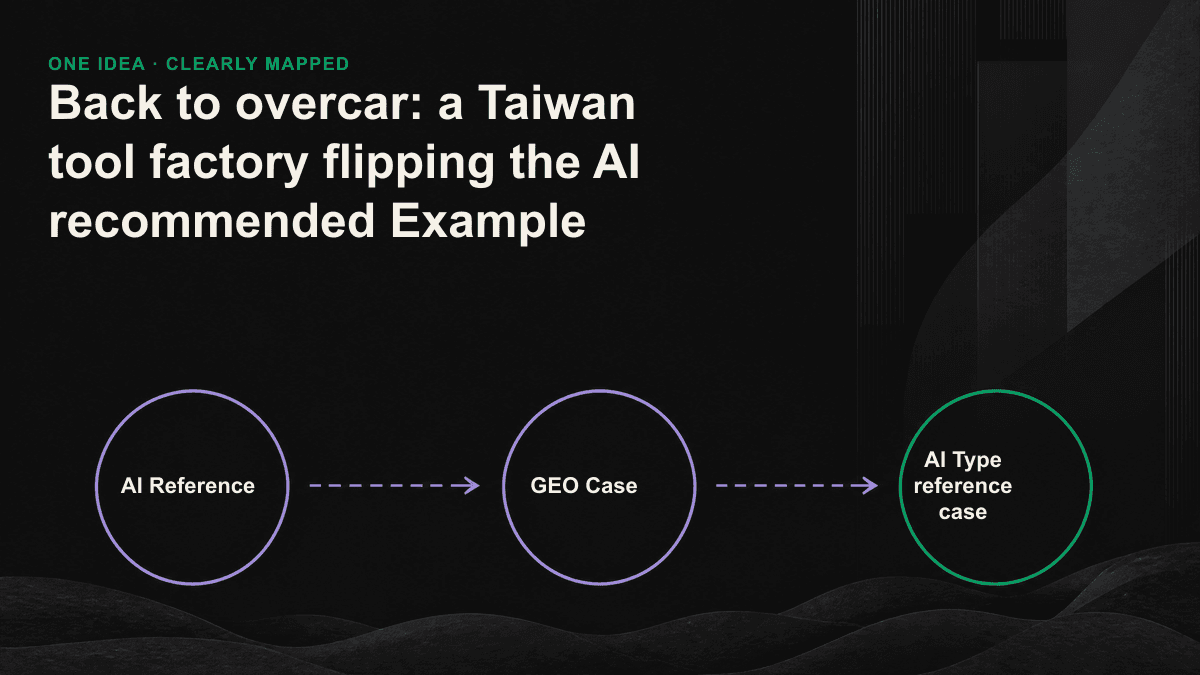
One of the five-axis processing centre manufacturers, who last year put almost all of the budget at fairs and Google Ads, disappeared when the buyer changed to ChatGPT, Perplexity to make the initial supplier selection - asking "the Taiwan Five-axis Processor" that AI had never given. 90 days later, the same team said it was stable in the first three. It's not an ad plus, it's not an external link, but a rebranding of the brands that the AI engine read.
The problem isn't ranking, it's "AI doesn't know you."
The company's official website appeared on page 2 for a Google search about five-axis machining centers, but ranking was not the main gap. Buyers were asking AI to list reliable Taiwan suppliers, and the model favored facts it could extract and verify across sources. This site kept specifications in PDF catalogs, gave product pages only a generic contact prompt, and buried technical advantages in unstructured marketing copy. To an AI engine, the company offered almost nothing it could quote.
We followed Brand Radar with the same number of shopping sentences as the four main competitions, and the result was straightforward: in the 20s, the competition was mentioned on average 11 times, the manufacturer was one time, and that time was classified as a "other option" supplement. It's not the product, it's the readability of the product in the eyes of AI.
Step 1: Find out who AI recommends and why.
We didn't change the website first, we measured first. In response to this type of product, we sort out what the buyer would really ask AI about, the intentions of comparing the rules, the due dates, the sale, and the suitability of the industry, and then run a test on several AI engines to record which brands were named, which sources were cited by AI and why.
- The recommended competition has almost a well-structured product page, with numbers (routine, speed, accuracy) written directly on the page, rather than locked into the model file.
- Their advantages have been repeated by third-party sources - industry media coverage, agency websites, forum discussions, so AI has multiple corroborations.
- They clearly answered the buyer's questions on the page, like "Approved to fly or medical."
The list itself is a road map. It tells us that there are not more traffic needed to get into the list of recommendations, but three things: extractable facts, verifiable statements, and a positive answer to the content of the shopping sentence.
Step 2: Move the hidden facts to the place that AI can read.
Change to focus on content structure rather than visual design. We move each of the key rules from the PDF to the main product page, display the X/Y/Z process with a clear field, main axis rotation, positioning accuracy and suitable material, and say, at the top of each page, "Who is the best fit for this machine and what sort of processing problem?" This writing is friendly to human buyers, and the extraction of AI is even more important - model preference for the whole quote, without needing to be extrapolated.
AI won't make up for your brain. You don't write the fact that it reads, in its world it doesn't exist.— Tenten GEO consultant team
Continue to address the issue of authentication. We helped the company to put together a publicly available technical article on what it has done (a medical client's case of processing, a positive data on the rate of a flight of spare parts), and to get agents and industry media to quote the same set of facts. When the same idea emerges in multiple independent sources, AI's confidence in it will increase significantly, which is also a prerequisite for its willingness to name a brand.
Step three: Answer the buyer's question and skip the sales pitch.
The tool machine has a set of regular questions: how long does it last, whether it fits with special kits, after-sales coverage, and the difference between competing products? We're putting these questions directly into the structure of the product pages and the FAQ, each giving a self-contained, single-quoted answer. The effect of this is two-way: the buyer finds answers on the page, and AI can use them as a recommendation when it produces a response.
90 DAYS LATER: From one reference to the first three stables
The 90th day runs the same 20th set of questions, and the number of times the manufacturer was mentioned rose from 1 to 13, eight of which was recommended as the top three and five of which appeared in a positive comparison. More notably, the question type: it's started to be named in the "Taiwan Five-axis Planter for Medical Treatment", which is exactly what we're trying to add to the facts and the case. The industry also reported that two new sets of information boards directly said, "It's ChatGPT that recommends you."
AI category recommendations require ongoing work. Competitors move, models change, and recommendation share needs continued monitoring. The manufacturer now treats Brand Radar's monthly tracking like a standard performance dashboard. When a query group drops out of the top three, the team returns to the supporting content and fills the evidence gap.
Three things that can be reproduced in this case.
- Measure first and do it: I don't know who AI recommends now, why, any adaptation is guessed.
- Move the facts out of PDFs and marketing copy, then publish them in a structure AI can parse.
- Multiple sources of evidence in exchange for real results, giving AI a reason to trust you, not just your URL.
And if you want to know, when the buyer asks AI about your type, whether you're on the list, to whom, to where, the fastest way is to do a test. Our GEO audit will use the same methodology to compare your AI-type recommendations to major competitions. We'd like to start with our own gap, and you can book a 30-minute GEO diagnostic session, and we'd like to read it directly with your class statement.