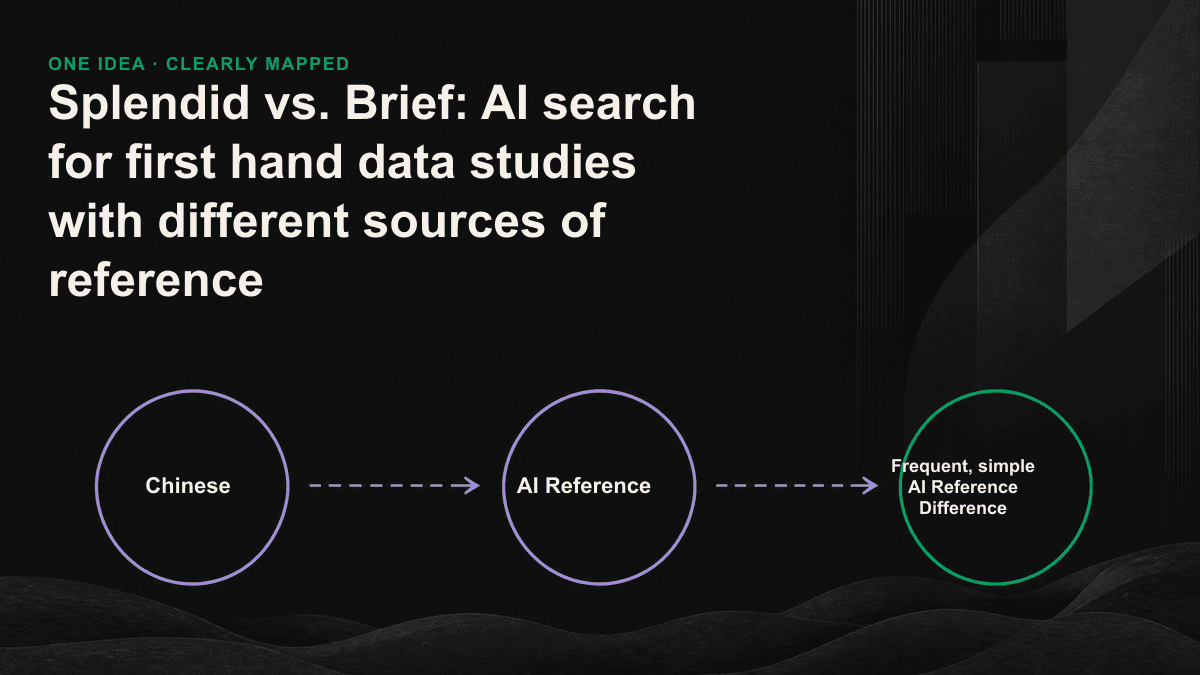
Ask ChatGPT the same question in Traditional and Simplified Chinese and the sources behind its answers may be almost entirely different. We tracked 320 B2B queries across three major AI engines and found a median cited-domain overlap of only 18%. A Taiwan brand can therefore have substantial visibility on the Simplified Chinese web while remaining absent from Traditional Chinese AI answers.
One Question, Two Source Sets
The study used 320 questions that Taiwan B2B buyers actually ask, covering SaaS selection, payments, information security, and recruiting tools. We prepared each query in both scripts and changed the vocabulary as a real user would: for example, Traditional Chinese uses terms equivalent to "software" and "mobile device," while Simplified Chinese uses its local forms. On the same day and with the same account settings, we ran each version through ChatGPT, Perplexity, and Gemini, then recorded every linked source domain.
The overlap was unexpectedly low. Measured by domain, the two language versions shared a median of only 18 per cent of their cited sources, and one quarter of the queries had no source in common. Traditional Chinese answers favored media, industry blogs, government sites, and universities in Taiwan and Hong Kong. Simplified Chinese answers leaned toward mainland technology media, Zhihu, CSDN, and Baijiahao, whose Chinese name begins with the character for 100. The two source pools behave like separate libraries that rarely lend to one another.
The Traditional Chinese Source Pool Is Shallower and Easier to Enter
That shallowness is both a constraint and an opportunity. For the same question, a Simplified Chinese answer cites an average of 8 to 12 sources, with many competitors. A Traditional Chinese answer usually cites only 4 to 6 and often repeats the same domains. Because strong, citable Traditional Chinese content remains scarce, one well-structured, information-dense article can enter an AI answer more easily than many teams expect.
- For Traditional Chinese definition queries, Chinese Wikipedia and a small group of Taiwan news outlets occupy a large share of the cited positions.
- Comparison and selection questions, such as whether X or Y is better, draw from a more dispersed source set and leave more room for a strong article to enter.
- Without substantial Traditional Chinese content, AI rarely mentions the brand in Traditional Chinese answers, even when it is well known in Simplified Chinese or English.
- When Traditional and Simplified Chinese versions use inconsistent product names or descriptions, AI may treat them as different entities and split their visibility signals.
Why the Two Scripts Produce Different Citations
The gap is not random. It follows from how AI retrieves language-specific sources. Three factors push Traditional and Simplified Chinese answers toward different source pools.
- Difference in corpus size: The global Chinese web contains far more Simplified Chinese material. Retrieval indexes naturally lean toward it, while Traditional Chinese requires more precise matching to surface relevant pages.
- Fallback during live retrieval: For a Traditional Chinese query, AI systems often fall back to a small set of authoritative local sources, including Wikipedia, mainstream media, government, and education sites. Commercial content must clear that narrow trust threshold.
- Vocabulary and entity divergence: The scripts differ in more than character forms. Local terms for software, data, and servers change query rewriting and vector matching, directing each version toward a different document set.
Can Simplified Chinese Content Cover Traditional Chinese by Translation Alone?
Many Taiwan brands begin by converting existing Simplified Chinese or English content into Traditional characters. That changes the surface but not the context. Mainland vocabulary can still make the copy a poor match for a Taiwan-focused query. More importantly, data, cases, and platform names from another market weaken the local signal for both Taiwan readers and retrieval systems. Content that enters Traditional Chinese answers needs Taiwan usage, Taiwan cases, and Taiwan-relevant sources, not character conversion alone.
What the Data Means for Taiwan B2B Brands
For B2B brands serving Taiwan, the data has a defensive and an offensive implication. Defensively, visibility in Simplified Chinese or English will not reliably spill into Traditional Chinese answers; the brand may be absent from that separate library. Offensively, the Traditional Chinese citation pool is shallower and less competitive. Building structured local content now costs less than entering three years later, and early brands can hold the positions that engines cite repeatedly.
In Traditional Chinese AI answers, absence costs more than a lower position. A lower-ranked brand still enters the candidate set; an absent brand is never considered.— Tenten GEO
Measure Traditional Chinese Visibility Before Producing More Content
Start with a baseline. Choose 20 to 30 questions that potential customers genuinely ask in Traditional Chinese, run them through ChatGPT, Perplexity, and Gemini, and record every cited source and brand mention. The brand may appear far less often than its Google rankings suggest. That difference is the gap to close next. To avoid manual comparison and see a systematic visibility score, book a GEO diagnostic session lasting 30 minutes. We will use Brand Radar to show the brand's actual position in Traditional Chinese AI answers.