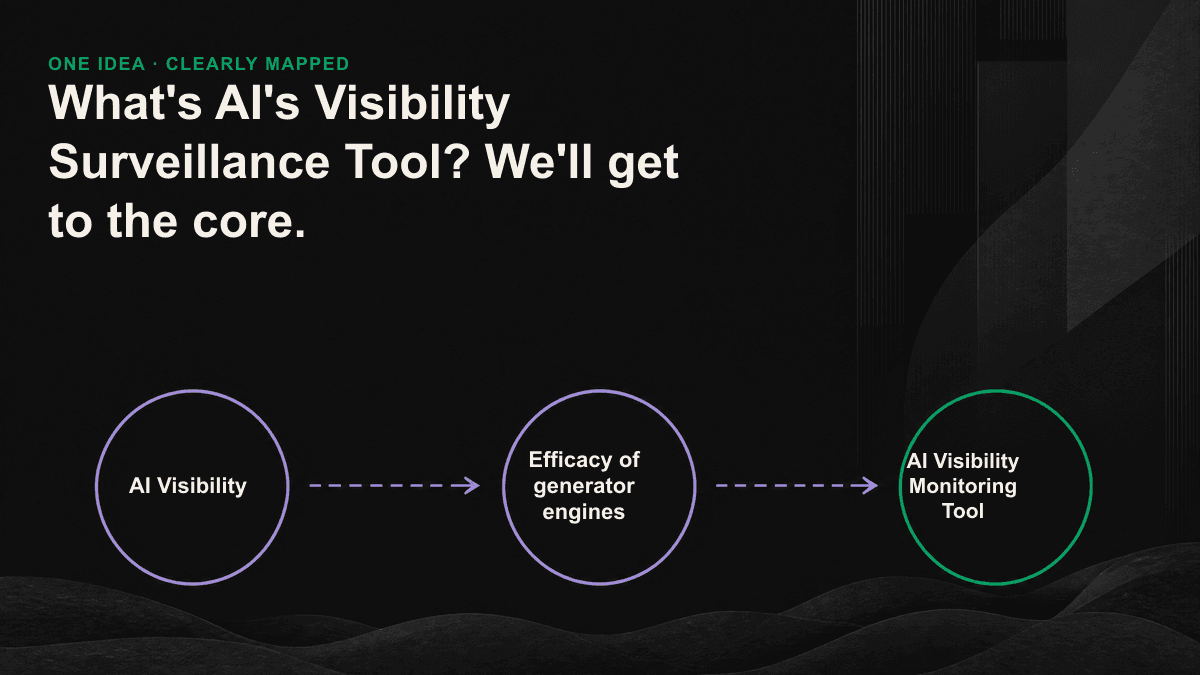
An AI visibility monitoring tool repeatedly sends questions to ChatGPT, Perplexity, Google AI Overviews, Gemini, and other generative engines. It records whether a brand appears, where it is placed, which source is cited, and how the answer describes it. This is not keyword rank tracking. It asks whether your brand appears when a prospective customer requests a list of useful tools.
What Does AI Visibility Monitoring Measure?
Traditional SEO tracks where a page appears in Google results. AI visibility monitoring asks a different question: when the user reads a generated answer without opening any result, did the answer include your brand? The two signals can diverge sharply. In client audits, we sometimes find a brand in the top three organic results while Perplexity cites three unfamiliar competitors for the same topic. The ranking is strong, but AI visibility is zero.
A useful tool measures three dimensions. First is presence: does the answer mention the brand at all? Second is position and share of voice: how prominently does it appear relative to competitors? Third is tone and accuracy: does AI describe it as a category leader, a low-cost alternative, or something factually wrong? Together, those signals give a fuller picture of AI visibility.
How It Works: Repeatedly Simulating Real Buyer Questions
The method is straightforward. A platform maintains prompts related to the business, such as "B2B email marketing software recommendations" or "which compliance tools serve this industry?" It sends them to several generative engines on a schedule, stores the answers, and parses the results. Think of it as a tireless market researcher asking hundreds or thousands of questions and turning the responses into data that can be compared over time.
- Build the prompt set. Create dozens or hundreds of natural questions based on the product, industry, and buyer stage.
- Query multiple engines. Repeat the prompts across ChatGPT, Perplexity, Gemini, and Google AI Overviews, accounting for different models and regions.
- Parse each answer. Extract the brands, order of appearance, cited links, and descriptive language.
- Compare competitors. Score the brand and its main rivals within the same answers to calculate citation rate and share of voice.
- Track change. Run the prompt set daily or weekly to see whether an update raises or lowers visibility.
Generative answers contain randomness. Ask the same question five times and the brand may appear twice but disappear three times. A single query therefore proves little. Repeated sampling is needed to estimate a stable rate. A serious tool reports how often the brand was cited across a hundred runs, not the one favorable answer it happened to capture.
The Core Capabilities
- Mention and citation tracking: Measures how often AI includes the brand across a defined group of questions.
- Competitor share of voice: Compares the brand's presence with its main rivals within the same answers.
- Source attribution: Shows whether AI cited the official site, a third-party review, Wikipedia, or a competitor, revealing which source deserves attention.
- Description and sentiment analysis: Checks whether the brand is presented positively, neutrally, or negatively and flags factual errors.
- Gap and opportunity detection: Identifies valuable questions where the brand never appears, often revealing the next topic the content team should address.
Source attribution is one of the most useful and most overlooked functions. Knowing that AI mentioned the brand is only the start. Knowing which page informed that mention tells the team what to fix. If an engine cites a third-party review from three years ago that contains an outdated price, the priority is to correct or displace that source, not publish another company blog post.
How Is It Different from an SEO Rank Tracker?
The clearest difference is the unit of measurement. An SEO platform follows keywords, rankings, and traffic. An AI visibility platform follows questions, citations, and share of voice. The first assumes the user will click a result; the second assumes the user may read the generated answer and leave. As more searches end inside an AI interface without a click, ranking data alone can give a false sense of the brand's actual exposure.
Three Common Misunderstandings
First, installing a tool does not improve visibility by itself. It measures the problem but does not write content or repair sources; it is a thermometer, not medicine. Second, one result is not a trend because the answers vary between runs. Third, a brand cannot interpret its score without competitors. A drop from 20% to 15% may mean a rival published aggressively, not that the brand's own content deteriorated. Wrong attribution leads to the wrong fix.
How to Choose a Tool You Can Actually Use
Evaluate four things: whether the platform covers enough engines, including at least ChatGPT, Perplexity, and Google AI Overviews; whether its prompts match the industry and buyer stage; whether it repeats samples enough to produce a stable signal; and whether it turns results into a clear next action. Measurement is only the starting point. The value lies in converting data into a content and source plan. Brand Radar follows this model by locating citation gaps across major engines and feeding them back into the content workflow. Book a 30-minute GEO diagnostic session to test your own topics and see where the brand appears today.