"ChatGPT citation" means that after the user asks a question in ChatGPT, the answer generated by the model directly lists your web page as the source, usually with a clickable source card attached. It has nothing to do with where you rank on Google. Instead of throwing you a bunch of links and letting you choose, ChatGPT writes the answer first and then goes back to mark who it cites. More and more people ask questions directly to AI instead of using search engines. Whether your brand can be cited directly determines how much visibility it has left in the AI era.
What exactly are ChatGPT citations?
To understand this matter accurately, first break down the three actions of "being crawled", "being retrieved" and "being quoted". After ChatGPT has search capabilities, when it encounters a question that requires real-time or specific information, it will first issue an online search, select a few pages from the results and read the context, then generate answers based on these contents, and finally put the source in the answer. Only when you complete the last step and your URL actually appears in the source card will it be cited. The page is read but is not marked, which is equivalent to not happening in terms of visibility.
How SearchGPT and ChatGPT search work
SearchGPT is an early search prototype launched by OpenAI. Its functionality was later merged into ChatGPT and became the built-in search you see now. When your question is time-sensitive, or involves specific brands, products, or prices, ChatGPT will determine that it requires real-time data and trigger a search. It is connected to the existing search index, which currently mainly comes from Bing and OpenAI's own crawling, rather than crawling the entire network on the spot. This means two things: your page must first get into the index, and after entering it, it must be selected and read by the model among dozens of candidate results. Only after passing both levels can it have a chance to be cited. Many people think that as long as the article is written well enough, it will be seen, but if the page is not indexed at all, the model will not even have a chance to read it.
What does the source card look like and where does it appear?
The source card is a small clickable reference block in the AI answer, usually showing the website name, page title and favicon. In ChatGPT web, this might be a dot within a line, a number at the end of a paragraph, or a "Sources" list below the answer. Perplexity is accustomed to ranking it in the top column of answers, and Google AI Overviews is placed as a link on the right. Each location is different, but the logic behind it is the same: the model wants users to go back and verify the source of the information, and that card is the entrance for traffic and trust to return to your website.
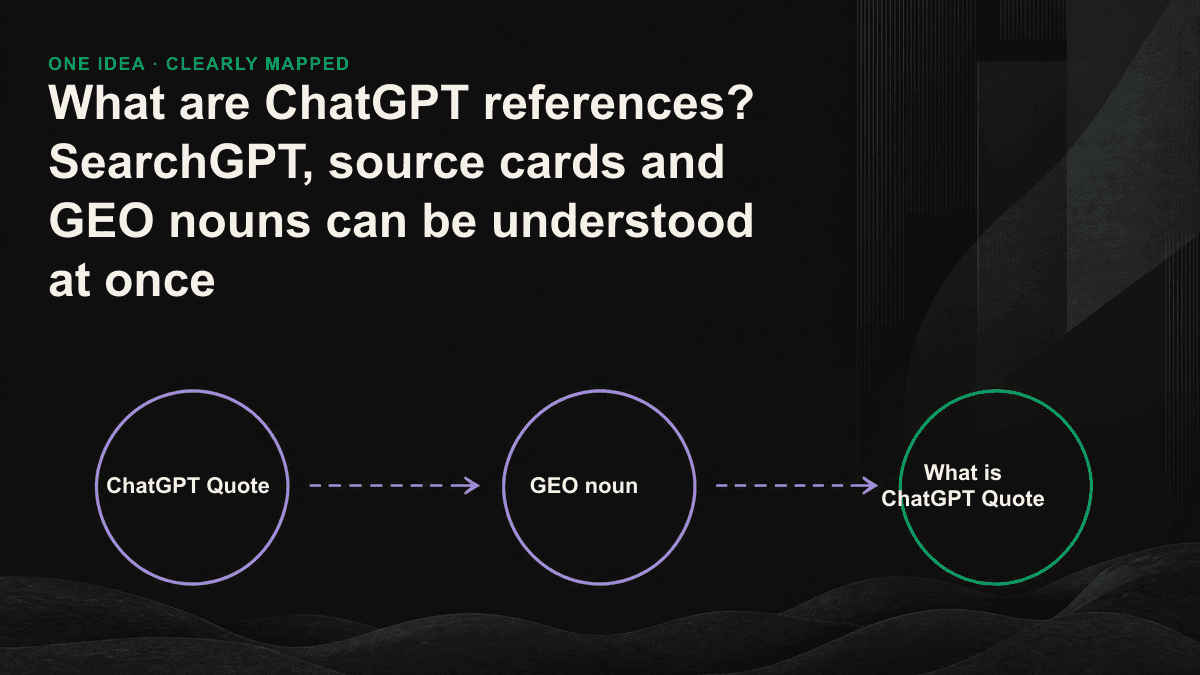
GEO noun list understood at once
The following nouns are core vocabulary that you will encounter repeatedly when reading any GEO materials. Remember them once and you won’t have to guess again later.
- GEO (Generative Engine Optimization): A set of practices that make content easier to understand, select, and reference by generative engines such as ChatGPT, Perplexity, and Gemini.
- AEO (Answer Engine Optimization): Focuses on making a single page cleanly answer a clear question so that it can be extracted as an answer; it is a close cousin of GEO, with a narrower scope.
- Source Card: The clickable block in the AI answer indicating the source is the real entrance to visibility and referral traffic.
- Grounding (grounding/retrieval enhancement): Read external data before generating the model and anchor the answer to a verifiable source. Citing occurs in this step.
- First-turn Advantage: Pages that are referenced when users ask questions for the first time will be recorded in the conversation context by the model, making it easier for subsequent questions to be repeated.
- Crawl, index, cite: Crawl is when the machine reads your page, index is when it is included in a searchable database, and citation is what really appears in the answer. All three are indispensable.
Citations do not equal rankings, that is the point
The success or failure of traditional SEO depends on which column you are ranked in the search results, and users still have to click on it themselves. The logic cited by ChatGPT is exactly the opposite. The answer has been written for the user. What you want to grab is the position next to the answer. Here’s the uncomfortable truth: Google comes first, and there’s no guarantee that ChatGPT will cite you. When selecting sources for models, they pay more attention to whether the content can answer questions cleanly, whether the structure is well extracted, and whether there are clear claims and figures. When we do audits for clients, we often see that some pages have stable rankings in Google, but have never received any AI answers. Let’s take a common situation. A 2,000-word product comparison article hides the key points in the third paragraph of the narrative. People can read it, but the model cannot come up with a clean answer, so it instead quotes another competing product page that writes the conclusion in the first sentence under the title.
If you want to be cited, where to start?
If you want to start being quoted, first make sure that the technical aspects are not in the way: whether the robots.txt allows AI crawlers such as OpenAI to be used, whether the main content of the page can be read without running JavaScript, and whether there is reasonable structured data. Then rewrite each important page into the form of "a question and a directly quoted answer", with the conclusion at the front and the definitions and numbers clearly written. Finally, you need a way to confirm whether you have been quoted, instead of guessing based on your feelings. AI visibility monitoring does exactly this, continuously tracking the mentions and citations of your brand in various AI engines, turning "whether there is an answer" into a measurable indicator.
Understanding these nouns is just the starting point. The real difference lies in how many pages you have are actually referenced by ChatGPT, and how many of them should be referenced but are absent. If you want to know where your gaps lie, you can book a 30-minute GEO diagnostic session. We will use your real brand name to check the citation status of several key issues on ChatGPT and Perplexity on the spot, and tell you the three things you should fix first.