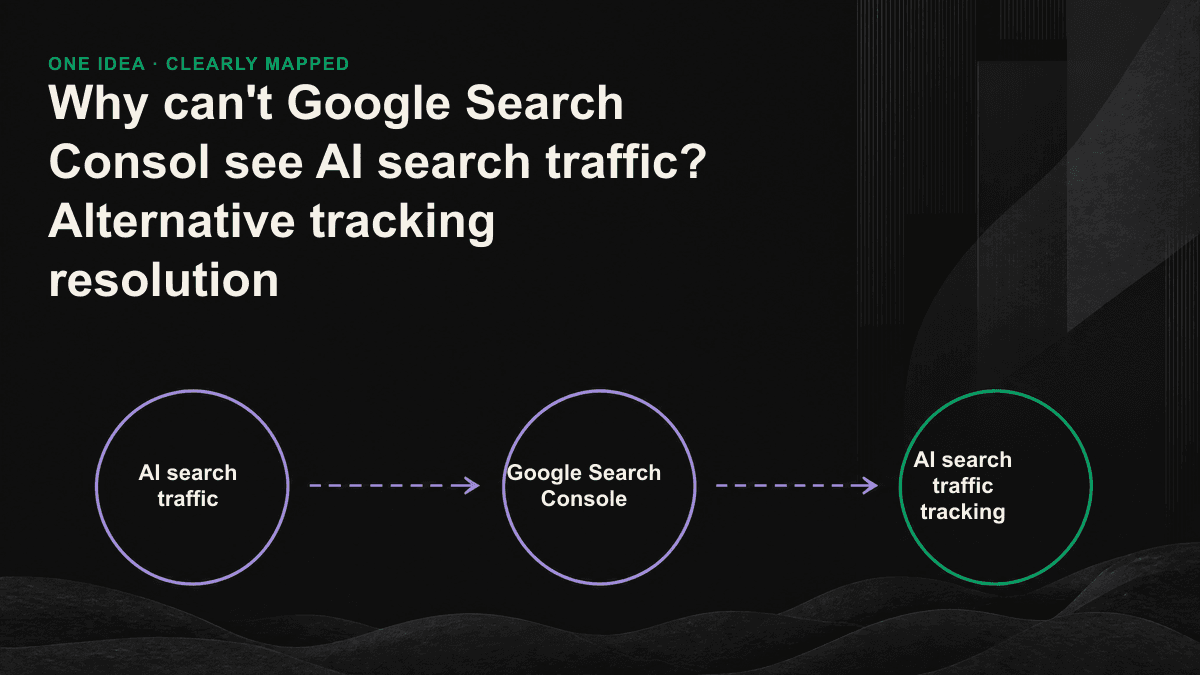
Open Google Search Console, every exposure and click you see comes from Google.com's search page. ChatGPT quotes you, Perplexity puts you in the source list, Gemini App mentions your brand in the conversation, and none of this will appear in the report. The problem is not that you left out some tracer code, but the GMC measuring boundary would have ended with Google. If you want to know how much visibility the AI search brings you, you have to accept one thing: the existing SEO dashboard doesn't measure it, and you need another way.
GSC only returns Google Search, AI engine is not in its eyes.
The GSC's results report is very specific: your web page appears several times in Google's search results, has been ordered several times, and is ranked in the highest order on average. It only comes from three interfaces (search, Discover, Google News), all of which are Google’s own surface. In other words, this is a report on how Google treats your website, not a report on how users find you on the whole network. As long as one exposed page does not pass the Google search, GSC does not have any columns to install it, it does not show zero, but does not exist in this data.
There's a lot of misunderstanding here: since AI Overviews is the function of Google itself, can you see its data? The current practice of Google is to add a click from the AI section directly to the general search effect, without breaking it to separate dimensions. As a result, you can see the total number of hits on the site, but you can't match the one from "AI Overview" alone. Visibility is mixed into a big pool, which is not much different for measurements.
Why is the third-party engine completely gone?
Third-party engines are even more demanding: ChatGPT, Perplexity, Claude, Microsoft Copilot are not Google searches, and they have their own pipelines and generation processes. When users get your content on these interfaces, they don't go all the way to google.com, and GSC doesn't get a single one. It's not a delay, it's not a sample error, it's a structure blank. Turns out that there are three types of visualization of the AI search, each responding to a different tracking blind zone:
- AI Overview Reference: In Google, the data exists, but it is merged into general effects and cannot be measured in a single way.
- Third party quoted and hit a little bit: the user connects from ChatGPT or Perplexity points, leaving a referral source that can be traced to GA4 but is often intercepted or wrong marked.
- Zero click quote: AI finishes the whole paragraph and the user is not on your website. This is the largest and most difficult piece.
How much can GA4 add: referral tracking practices and limitations
GA4 is currently the most practical way to recover the portion of third-party AI traffic that includes a click. Open the Traffic acquisition report, filter AI-interface domains with Session source, and save the result as a custom channel group or reusable segment. Sources worth tracking include chatgpt.com, perplexity.ai, gemini.google.com, claude.ai, and copilot.microsoft.com. Grouping them under AI referral reveals whether traffic from this channel is rising or falling.
This method has three inherent limits. First, many AI apps run natively or rewrite the referral header, so visits appear as direct/none and disappear into direct traffic. Second, some citations use redirect URLs or send no referrer, which breaks the signal before it reaches analytics. Third, zero-click citations never enter GA4: the user reads the answer, sees your brand, and leaves while analytics records nothing. GA4 therefore measures only the subset of people who click through.
Add the "Crawled" floor to the server journal.
There's an earlier signal before the traffic: who's gonna climb you. Analyse the server journal or the CDN journal, and use the user journal to rip out the AI-related crawlers, and see whether the engines have come back for you. GPTBot and OAI-SearchBot, PerplexityBot, Anthropic Claude Bot, and Google-Extended are worthy of attention. To remind you that being crawled only means that you entered the pool, not that you were quoted; it is a necessary condition for visibility, not the outcome itself. A more practical view is to use the creeping frequency as an early signal - if an interview with a crawler suddenly falls, it is usually a precursor to an update or technical situation.
Measure citation rate, not click traffic.
If you add up the front floors, they're turning around the same gap: zero clicks. Since most users do not come in, the most honest measure is not to wait for the signal to come in, but to ask. The way to do this is to organize a set of prompts on the real tone of the target's clients, to throw them regularly into the ChatGPT, Perplexity, Gemini and Google AI overviews, and to record in turn whether your brand is mentioned, ranked in the number of pages, and which page is connected. This calculates the reference ratio to visibility, which is the real result indicator for the AI search. Brand Radar of Tenten turns this into a repeatable monitoring, making the citation rate a curve that can be tracked for a long time, not every time by impression.
In the AI search, visibility does not run into the report itself; you have to measure it with a prompt.
Form a set of three-level signals.
A single tool has a blind area, so it's clear: GA4 gives you the lower limit of "someone comes in," the server journal gives you an early signal "Is there a climb?" The prompt monitors your "Is there a quote?" At the rhythm, the prompt monitor suggests running regular theme groups every week to two weeks, and the other two floors look back once a month. There's really only one question to answer: is your brand visible in AI's answer, higher this month than last month, lower? If you want to know where you're at and what key prompts you don't have, you can schedule a 30-minute GEO diagnostic session, and we'll show you what you're doing with your real issues.