Perplexity will not quote your list, and most of the time it will be the structure, not the pen. Most of the Best-X articles are not quoted because the authors consider it a keyword for SEO to fill out the blanks, rather than an answer that can be extracted by machines. If you change the same content for a structure rewriting, the odds of citation are clearly different.
Why does AI engine prefer the list and skip yours?
When the user asks "What's the best X," the AI engine will pre-empt the item, because it can be asked directly. Your list has been omitted for three reasons: the format of the items is inconsistent and the model cannot be aligned; the focus of each item is buried in the narrative paragraphs, and the cost of extraction is too high; there is a lack of cross-referenced columns, and models cannot be rated in order. When it comes to this content, the model leads to a cleaner structure.
There's a counterintuitive place here. Articles are not the same thing about the readability of human readers and the extractability of models. It's a well-recognised, readable, but model has to be detached; it's a set of fixed, well-informed items that people may feel like a pattern, but the model can read and quote at a time. If you want to be quoted, you have to write for the machine, then you have to decorate.
A list that could be quoted.
Fix the entire outer structure. On this level, it's decided if the AI engine can identify "this is a complete list of questions" in a few seconds.
- The title is a direct answer to questions: insert user typed words, such as "the best B2B SaaS analysis software in 2026" instead of "the best tool we choose."
- The first paragraph begins with an answer: summing up the conclusions and selection criteria of the entire list in two or three words, allowing the model to draw this summary directly.
- The number of entries adds to the title and goes on: seven, the text is seven, not much.
- Each entry is in the same column: name, location, suitable target, key data, strengths, weaknesses, determinations, fixed sequence.
- Attach a table of key columns to all items and the model is most easily quoted in the entire paragraph.
Five-column skeleton for each item
When the outer layer is fixed, what really determines the citation rate is the internal structure of a single project. Gives each set of fixed columns, written like a form, and does not take them with a love paragraph.
- Name and position: The first sentence makes it clear what it is and what it solves, such as "Xx is a self-help analysis software for large and medium-sized teams".
- Applies: To whom, not to whom, to help model the user context.
- Key data or criteria: Concrete facts such as starting prices, supporting languages, integration numbers, data ceilings can significantly enhance credibility.
- two or three points each: both are written, and models are more willing to quote because they look neutral.
- One sentence: Say "If you value X, choose it" and give the extractable conclusion.
The value of this column is consistent. When all seven projects are based on the same column, the model is easily cross-referenced, and when the user asks which is the cheapest, which is the support Chinese, he can extract a precise response to the column. This ability disappears once columns or columns are missing in order.
Start with 40.
When the AI engine decides whether to quote something, it eats the first few sentences. In the first sentence of each project, please go directly to location and judgment, and do not open the door with the phrase "when speaking of this tool, we have to mention its long history". Puts the most quoted sentence at the top of the line, which is equivalent to sending the model an existing answer.
Several writings that make the citation zero.
- Replace the reality with a marketing phrase: "Full-powerful, industry-led" cannot be quoted, and "support 40 languages at 29 dollars a month" can be used.
- The field does not match: some do not write the price and the model cannot be compared.
- Hide the reasons for ranking in the long paragraphs: The model can't get you first.
- The title "Pre-10" is only six: the number does not match the credibility of the source.
- There's not a single photo form in the whole article: it's like abandoning the format that is most easily quoted in the whole paragraph.
Turn the template into a repeatable process
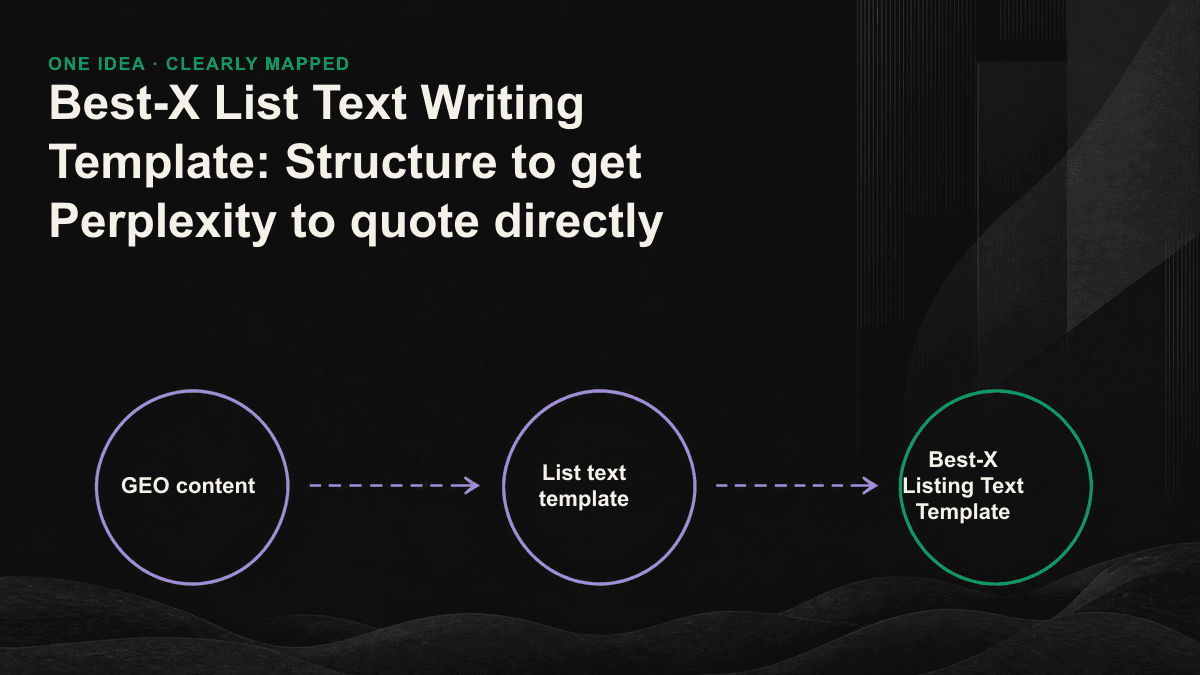
A good piece is just the beginning. The real thing is to turn this skeleton into a template, and each list will be produced with the same external structure and five-column frame, and then fill out the subject. This is how the Tenten GEO's content engine works: first define the structure that can be extracted, then scale chemical production, and use Brand Radar to track which lists are actually cited by the AI engine and which sections are quoted. You know what to add to the next one.
If you already have a list of texts that you can barely get an AI quote, the question is in structure, not in subject matter. You want to know which piece of content is missing in the eyes of the perplexity and ChatGPT engines, and you can book a 30-minute GEO diagnostic session, and we'll pick out a couple of actual pieces for you.