The old language is not worthless, it's "not able to get out." Most of the AI engines read your article three years ago, and the problem is that your paragraph hides the answer in the third sentence, burys the conclusions behind a long line, and the model does not catch a clean line that can be quoted in the whole section, so it skips you and quotes others. For old languages that already have natural rankings, recasting the paragraph level is faster than writing a new article.
Why, AI can't use your old language.
The AI engine, which collects answers in paragraphs or smaller blocks, requires a brief statement with the main body, the head office, and a certificate. The traditional SEO articles often split a point: two or three sentences in front of the situation, the middle of which leads to a conclusion, followed by a restatement. This writing makes humans read well, but the small piece that the model captures often lacks key information, cannot stand alone and will not be chosen as a source of reference.
There's a quick self-censorship. Do you understand? Can you answer a clear question? If you need to slide up to know what "it" means, which "this" approach is, then you can't smoke it, and AI can't use it.
Past and Beyond: Two versions of the same phrase
Using a question common to B2B SaaS: "How long will SEO be effective?" "We have to look at the original writing of most old languages.
Before the transformation: Many B2B SaaS teams are concerned about the effectiveness of SEOs today in the context of growing digital marketing competition. In fact, there are many factors involved, including the importance of the website, the frequency of content production and the level of competition in the industry, which makes it difficult to provide a standard answer that requires further analysis and evaluation.
After remodelling: The SEO of B2B SaaS usually takes between 6 and 12 months for steady organic traffic to grow. Most of the new domains with less than a year on the line are 9 to 12 months old; the already strong domain can be reduced to 4 to 6 months. The variables that affect the time course are sorted in order of priority: existing domain weights, monthly number of releases, goal keyword competition.
What's the difference? In the revised version, the first sentence is an answer that can be quoted in the entire paragraph; the numbers are specific and conditioned; the vague "many factors" are replaced by three variables. The model captures this section, and can answer "the SEO of B2B SaaS takes about 6 to 12 months" and label it as your brand. The original version was captured with only "involved in many factors, difficult to get a standard answer" and nothing.
Four-paragraph modification actions
- Preface the answer: Move each of the most appropriate quotes to the first sentence, and put the situation back behind it or delete it.
- One paragraph is a summary: one paragraph says one thing, and then it closes, so don't stick three points in the same paragraph.
- Complement physical and numerical: the sentence should contain a clear body (who, which product, which market) and a verifiable number or condition, not in a "many" word.
- Add a self-contained link: replace the pronoun (it, this, above) with a pronoun that allows the paragraph to be read out of context.
These four actions do not require you to rewrite the whole thing, nor move the title or the web site structure. You keep the original ranking asset, and you just adjust it from the order of "humans slip" to the structure of "models take place". In most cases, there is only the first sentence and the replacement word to be changed.
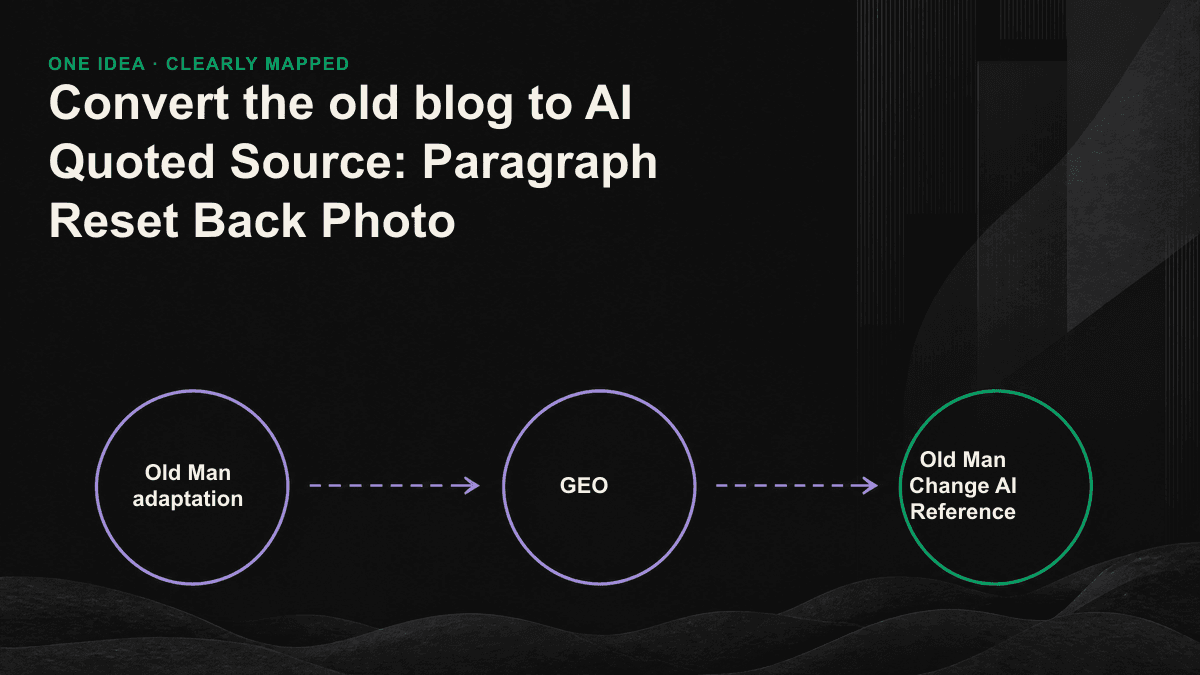
From what?
Don't do it all at once, it'll be long and difficult to verify. Three articles will be locked: an information article that is listed 10 years before the nature search, but which is not quoted at all by AI; an article whose title is itself a question-and-answer article; and a theme that you most want to be connected to the brand, usually a key page for your core service. These three articles are based on good, well-intended, and are the fastest to see the AI citation shift after re-engineering.
How do you know it works?
The modification is not finished with the file. You have to take the target question, in fact, to ChatGPT, Perplexity, Google AI Overviews, asking each of them to record the last three things before the change: whether the brand was mentioned, whether it was linked, whether it was quoted in full. That's exactly what Brand Radar's tracking for. Turning it into a fixed monthly measure, you know what really drives the quote instead of saying, "Looks like more."
We can change a few pages a week.
Restructured paragraphs in an editor's rhythm in an old language about 1,500 words, about 40 to 60 minutes, a week row of 5 to 8. The true neck is never about the speed of the rewriting, but about the choice of the right article and the question of which to verify. If you want to see which articles are closest to the whole of your old library, "One more will be cited by AI," you can set aside 30 minutes for a GEO diagnostic sessions, and we can run a gap point with your live URL, sort out the priority articles.