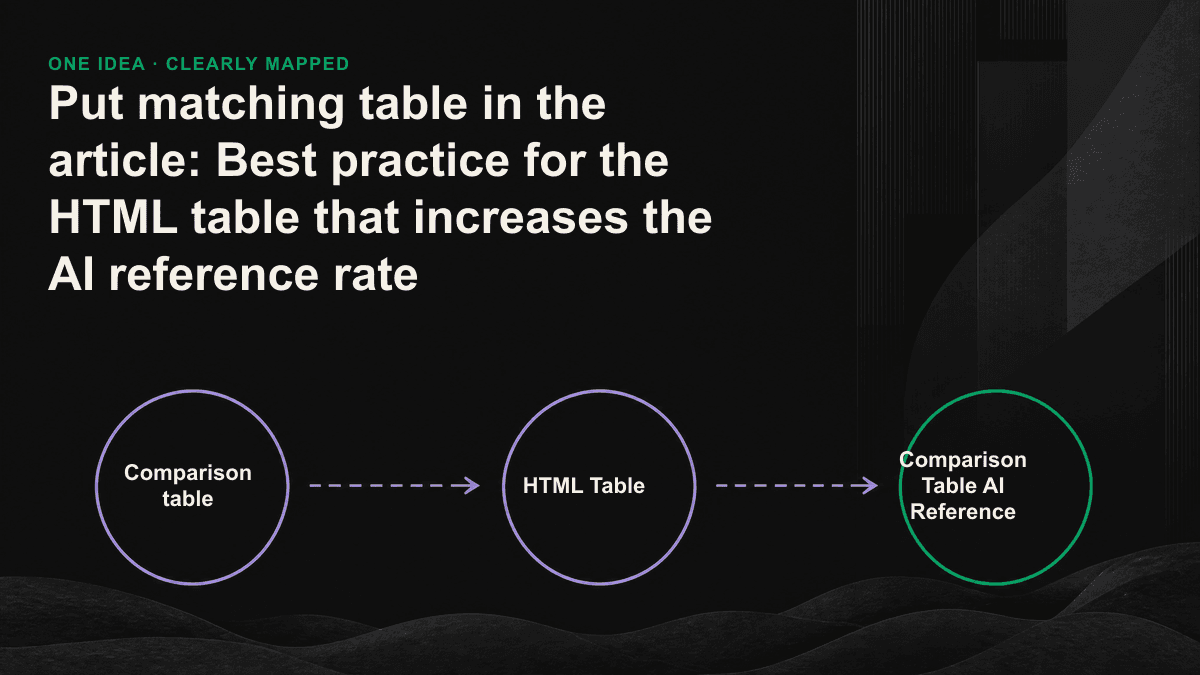
To make an article more often quoted directly by ChatGPT, Perplexity, the most economical move is not to add words, but to produce a clean HTML form for the comparative information scattered in the paragraphs. The AI engine has a special preference for capture of constructed contrast data when generating answers: a dimension corresponds to a value, source is clear, and can be validated on a case-by-case basis. The same phrase, "A is cheaper than B, but B is more integrated", is written as a table that is drawn out as a source, much higher than the long sentence hidden in the fifth paragraph.
Why, AI, the engine is particularly fond of bite forms.
When the large language model is read on the web, the essence is to look for "matchable data". The rows and columns of the table are themselves a set of clear keys: this column is a tool, the columns are price, integration, starting time. The model does not have to disintegrate itself from a conversation about who to respond to, nor does it have a low cost or probability of error. When the user asks "X and Y which is cheap," the model quotes first the table that already sets the price in parallel, instead of reading the three words itself.
There's a big difference in practice. When we rewrite the comparative pages for clients, it is common to see that the contents are in fact complete, but they are all narratives, and that they are completely absent in Perplexity’s references. Move the same information into a marked table, the rest of it remains unchanged, and will start to appear in the list of sources of AI answers in two or three weeks. It's not content. It's extractability.
Use semantic HTML, not graphics or layouts
The most common and damaging mistake is turning a table into an image or arranging div elements with CSS so the page merely looks like a table. A person may see no difference, but a machine does. Models often cannot read the text inside an image, while a div-based imitation has no row or column semantics. A native HTML table gives the extractor a structure it can parse reliably.
- Use tablets, theheads, tbody tags to separate the watch from the inner text so that the model knows which column is the field name.
- Each field is marked with a td, a value in the data grid, not with the same guese.
- The first column places the "relative body" (e.g. a tool name, a program name) and the subsequent columns keep a single dimension and maintain a row of objects.
- Avoiding cross-column and cross-column (rowspan), which would upset the alignment of the line, and the extractor would easily be wrong.
- Caption label writes a sentence about what this table is compared to, which is equivalent to giving the model an existing quote.
What's in the form, decides whether it's going to be quoted.
The structure is just a doorblock, and the content determines the value. The AI engine prefers to quote a table with a "specified and verifiable value" rather than an entire row of vague comments with a "good" "sanctionable" "support". It's better to write "120+Integration" than to fill the "rich" column with "120+Indigent"; and to write "quick" with its hand, it's "about 30 minutes to complete the initial settings". The exact number makes the cell itself a recalcitrant fact, and the vague adjective is overrated by the model.
Field selection matters just as much. Use dimensions that readers actually compare: price, plan, key constraints, team size, and Chinese-language support. Do not add feature columns that no one uses to make a decision. A table with three to six columns and five to eight rows is easier to cite than a table with 20 dimensions because it stays focused on one question and the model can extract it as a unit.
Let the forms read as well as people.
The form can't only serve machines. The time and credibility of the stay will be harmed by the fact that the device's watch, too many columns across the border, will be squeezed and the readers will be halfway out. The practice is that the table maintains a complete table, that the action device allows the table to scroll horizontally, or that the sheet is stacked on a narrow screen with a small card per column, but the bottom-floor HTML retains the original table structure and does not remove the tone for resonance. The structure for the machine and the layout for the audience can be based on the CSS division of labour without having to choose one.
- Above or below the table, the conclusion of the table is summarized in a single sentence, such as "A for a team of less than 10 people, B for a progress report", which is often summarized by AI.
- The header uses clear terms, not abbreviated or inner black words, and models and readers have to read.
- Digital units and formats (both NT$ and monthly fees), consistency makes machine interpretation more stable.
- A number from the source examination is attached to the source or the date of the update to increase the credibility of the reference.
- A table answers only one core question and needs to be more oriented and split into more focused tables.
If a comparative table is removed and each cell is a specific and verifiable value, it will be quoted as a fact by AI; if it is a vague comment, it will only be taken as an oversight of your personal opinion.
Add structured data, but not reverse.
Some teams will ask whether to add schema tags to the form. Based on the behaviour of the current mainstream engine, clean original HTML forms are in themselves good enough to be deconstructed, and Schema.org's structured data is more than a precondition. If this table responds to a clear question-and-answer scene, using FAQPage or web level to supplement the structured data, it will make it easier for the engine to link the whole section to a question. But write the HTML form correctly, and then talk about schema; the order is reversed, which is equal to embellishment on the deviating foundation.
A list that you can check.
Next time you put a matching table in the article, you check yourself with three questions: is this original HTML table or a picture or a fake table? Is it a specific value or a vague adjective? When the watch is covered, can the reader tell what the column says? This table also serves the decision and AI extraction of readers. If you want to know how much of the comparative information you have is contained in pictures or essays, and how much of the AI citations are lost, you can schedule a 30-minute GEO diagnostic session, and we can identify the gaps that can be filled most quickly.