The AI engine rarely reads the full text and judges it, and it tends to be accessed directly from the most "clean" section. If your article starts without an independent definition or conclusion, even if it ranks in the top three in Google, it is often skipped in answers from AI Overseas, Perplexity or ChatGPT. It's not about layout, it's about deciding whether you're going to be quoted as the first door.
Why does the opening paragraph determine AEO's hit rate?
When the generator answers a question, it cuts the selected web page into a "referenceable unit" and selects the most complete and relevant part of the question. This system is particularly unfavourable and beneficial to the start: to the detriment of setting the stage (the background, the trend, the last point). So that the first reference is a message without information; the advantage is that if you say, "What is this, what is the answer?" It's clear that the engine can barely be pumped out.
When we were doing the GEO audit for B2B SaaS, the most common problem was not that it wasn't deep enough, but that it was buried after the third part. A technical article on "API Speed Limit", which really defines the position after three slides, starts with an entire paragraph on "API Economy." As a result, Perplexity quotes an article from the competition that is even thinner, but that is defined in the first sentence. Depth is down to position.
Definition Paragraph: Let AI recognize "here are answers"
The definition of the paragraph is an independent text that is put in front of the article and used to answer "X what". Its mission is not to get interested, but to allow machines and people to understand the subject matter and take a complete answer without looking at the context. It's written with a few specific requirements, and without a hit rate, it falls.
- The first sentence is defined by the phrase "main word is" and does not open with a question or context. For example, "TL; DR Abstract is a text that starts with two or four words to condensate the core of the conclusion."
- Place the target keyword in the main word of the definition sentence so that the words are consistent with the query, not at the end of the sentence.
- The definition is to be independent of the title. Suppose the reader sees this part, doesn't see H1, still knows what you're talking about.
- Controlled in 40 to 80 words. It's too short to smoke, too long to be cut in half by the engine.
- Avoid starting with aliases. "It" "this" will take away the clips taken and the engine will usually give up directly.
TL; how do DR abstracts work?
TL; DR summary and definition paragraphs are different: definition answer "what," TL; DR answer "so what's the conclusion, what should I do?" It is appropriate to start with a teaching, comparative, and perspective-type article, and to finish the most important judgment in two or four words, so that both the time reader and the AI engine can read it and get the answers available.
Practically, a good TL; DR will do three things at the same time: make a clear conclusion, give a verifiable basis, and point to the appropriate target. For example, an article comparing two databases, TL; DR can write: "If your query is read-based, the data structure is stable, select A; if written frequently and schema changes, select B." Most of the early SaaS belonged to the former. "The reader does not have to go down to get an actionable judgment, which is what engines like most.
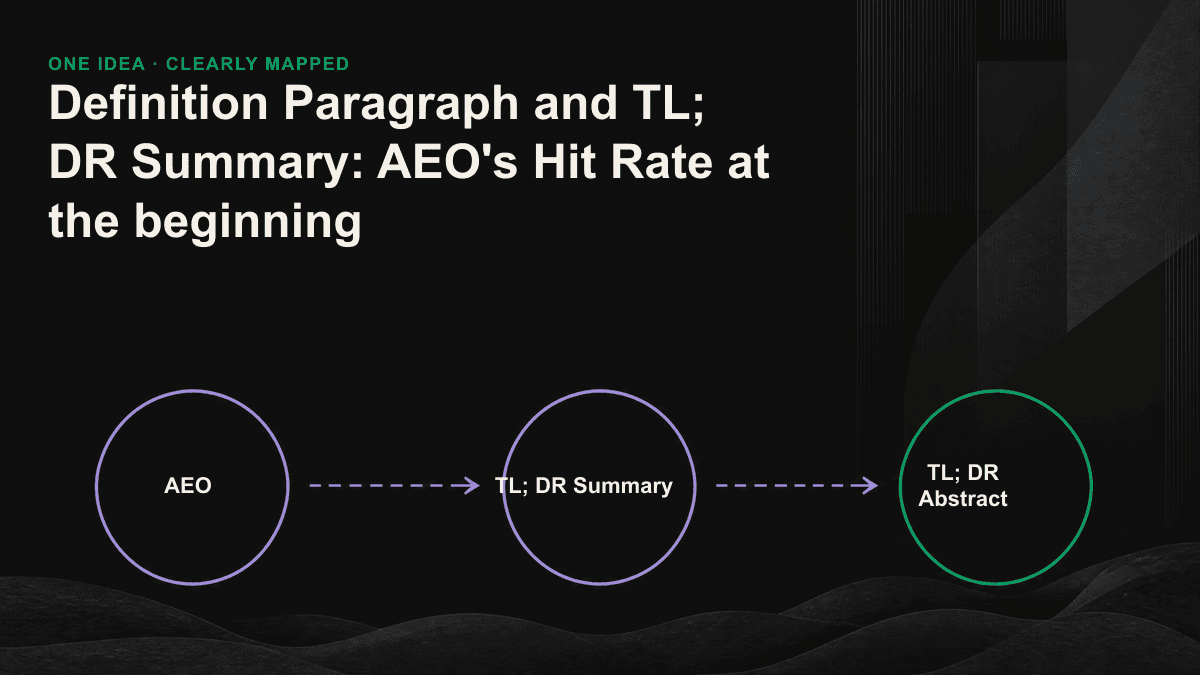
Defines paragraphs and TL; DR how to match
Both are not two or one. The starting structure of the highest hit rate is to pin the theme with a defined paragraph, then close to a T.L.; the DR finishes the conclusion and then opens the text. It defines what "X" is for you, TL, and what DR is for you. The same article is thus capable of receiving two kinds of dissenting questions at the same time, rather than rewriting them.
There's also the order. The definition is ahead, T.L.; the DR is later because the engine, when determining relevance, identifies the subject matter and then extracts the conclusions. If you put the conclusions ahead of definition, both readers and machines have to guess what you're talking about, and the score of alignment will drop.
The simplest three ways to start.
The first is the opening of the era. A sentence like "Ai today at a fast pace" does not contain any extractable information, but it occupies the first of its most valuable quotes, which is tantamount to leaving the door empty. The second is to ask the opening question. "Have you ever wondered..." pushed the answer backwards and the engine was a question, not an answer. The third is that the word "proximity" continues to be used to "show this" in the first place, so that the extracts are not understood from the context.
The ranking determines whether you are qualified to be seen, the opening paragraph decides whether you will not really be quoted. The former is a search game, the latter is an AEO game.— Tenten GEO content review notes
Consider the opening as an independent product.
Validation is simple: copy the first two or three paragraphs of the article, post an empty document, read only the text, and ask yourself, "Can you answer a true query alone?" If the answer is vague, it will also be blurred when the engine is drawn. One more step, ask ChatGPT or Perplexity directly, who it quotes, which part of each other's paragraph, and usually you find that the quote is the "first sentence is the answer."
This check does not require tools to do it, but to do a systematization of the page openings across the entire site, which pages are omitted, it is necessary to track the query template, the source cited, the location of the gap. AI visibility monitoring of Tenten is doing it: keeping an eye on your brands and... The key topics were quoted in the various AI engines and you were absent with what questions.
The opening phrase is the one with the highest rate of reporting in the AEO, changing a text and ranking, which could turn an article that had been jumped into a quoted source. If you want to know what quotes are missing in the opening paragraphs of your website, you can schedule a 30-minute GEO diagnostic session, and we'll ask you directly about your actual pages and a few sets of targets, whether it's you or your competitor who's taking the engine.