You spent three months making that white book that AI couldn't read. It's lying behind the paperwork, wrapped in a PDF file, can't catch ChatGPT, Perplexity won't quote, Google AI Overviews has omitted. The original data, methodology and client cases are the best references, but as long as they are "a file to download", they are no longer available for the generative AI engine. In order for this content to be visible for the brand, it has to be removed from the PDF web page.
Why is the PDF white book a dead end in GEO?
The generative AI engine has a clearly structured HTML that can be drawn directly. Even if the PDF is indexed, the columns, the graphics, the line breaks will break the extraction results, and it is difficult for the model to clean up a full statement. The key is the doorbell: filling in the form to download the contents, the crawlers can't get in, and locking the most valuable original data into the invisible room in AI.
Another problem that is often overlooked is "one to many questions." A 40-page paper often answers a dozen specific questions at the same time, but it has only one URL and one title. The AI engine is in question to find an answer, and a structured PDF connection does not respond to any explicit query. It is possible that a long document could be drawn from a dozen queries by splitting it into web pages that answer each question.
Start with the dots, then dismantle: find the assets to be quoted.
Don't rush to post PDF on the page. Scanning the entire document, page by page, to mark the paragraphs with real reference value. In the past, a solid white book worth a single page of assets has probably fallen in these categories.
- Original data and findings: The number you came out of yourself was AI's favorite quote, because nowhere else.
- Operational method theory or step frame: Dismantling "what to do" into a process that can be extracted from the column.
- Clear definitions and nouns: The model answers what "X" with a clean sentence first.
- Client cases and quantitative results: concrete and numerical, supporting the credibility of the model ' s answers.
- Anti-intuitive views or positions: Different ideas are more easily quoted alone than general conclusions.
After this exercise, each asset responds to a "question that readers really ask." An electronic book that removes eight to twelve of these problems is equivalent to eight to twelve independent quote entry points, not the original download link.
A document to tear down three web-based forms
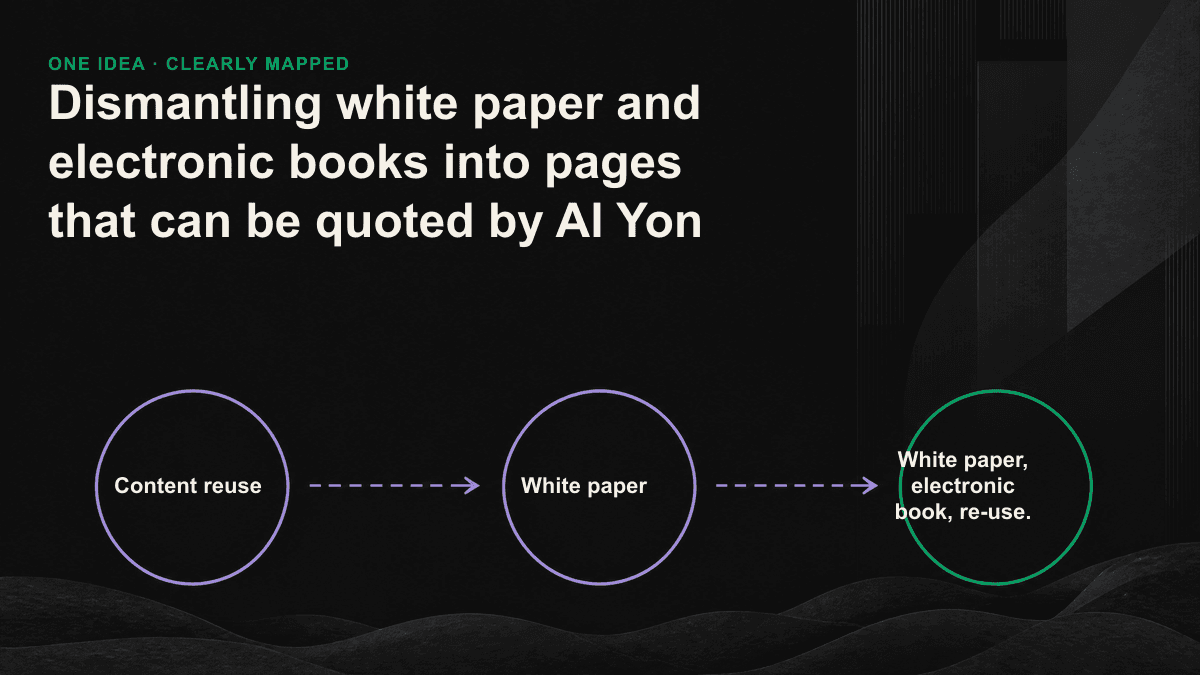
Dismantling isn't putting PDF content on the Internet. The same material can be developed into three complementary web pages, each serving different settings.
Pillar brief: Take over the core theme
Convert the main axis of the white book into a 2,000-word long web article, rewriting openings and conclusions, adding clear H2 subsections, and rewriting chart information into readable text paragraphs. This is the anchor of the theme, connected to all the sub-pages.
Subpage: One question for one page
Every single asset that comes out of the plate is a stand-alone page, the title is the question, the first paragraph is the answer, and the evidence is added. This page is the most friendly with AEO, because its structure is itself a "question-answer" model that can be quoted almost without a double-check.
Abstract card: for busy engines and readers
Put a 60 to 80-word summary of the "core conclusion" in the long text, and finish the full answer in the most rhetorical way. This is the location of gold extracted for AI and for readers who only want to conclude.
Rewrite, not copy on
Putting PDF text directly on the web is the most common failure. White books usually have a formal tone, long sentences and a lot of front lines, which happens to be AI's worst structure. The page should be rewritten: break the long sentences, refer the conclusions to the beginning of the paragraph, replace "the report considers" with a direct statement, and replace the chart with a stand-alone text. The goal is to get any part of it out alone and to read the context.
Addressing the risks of repeat content at the same time. If you keep the original PDF and post the same text, the search engine will be confused as to which one to receive. The way to change the web page is to use the PDF as the "extended download" instead of the only entry and to ensure that the web page is freely crawled out.
Fix the structure so the machine can read your assets.
Rewritten to HTML is just the first step, and the engine needs to know exactly what the page is answering. Ask a subpage to apply FAQPage or QAPage to structured data, methodical page with howto, long text with Article. The clear title level, one H2 for each question, and the fact that the answers follow it, which seem to be basic structures, are the basis for the model to judge whether it can be quoted.
And don't turn the page into an island. This internal connection allows the engine to understand the entire connection of the content and redistributes the cumulative weight of the single PDF to a dozen sites that can be searched.
Disassembly a download file into twelve web pages that each answer one question, not the more, where the original answer was finally found in AI.
You've got a couple of these white books and e-books on your hands. If you want to know which of the assets you have in your database are the best to dismantle and which AI queries you can handle, you can book a 30-minute GEO diagnostic session, and we will identify gaps and priorities.