When the AI engine quotes your article, it hardly reads the whole story. It draws out an independent text. If your focus is hidden in the seventh paragraph, you'll have to read the first six paragraphs, and the model won't be clean or quoted. It's not that you've been quoted a few times, but it's that there's a few pieces that can be cut off alone and can answer questions.
What is the meaning of words?
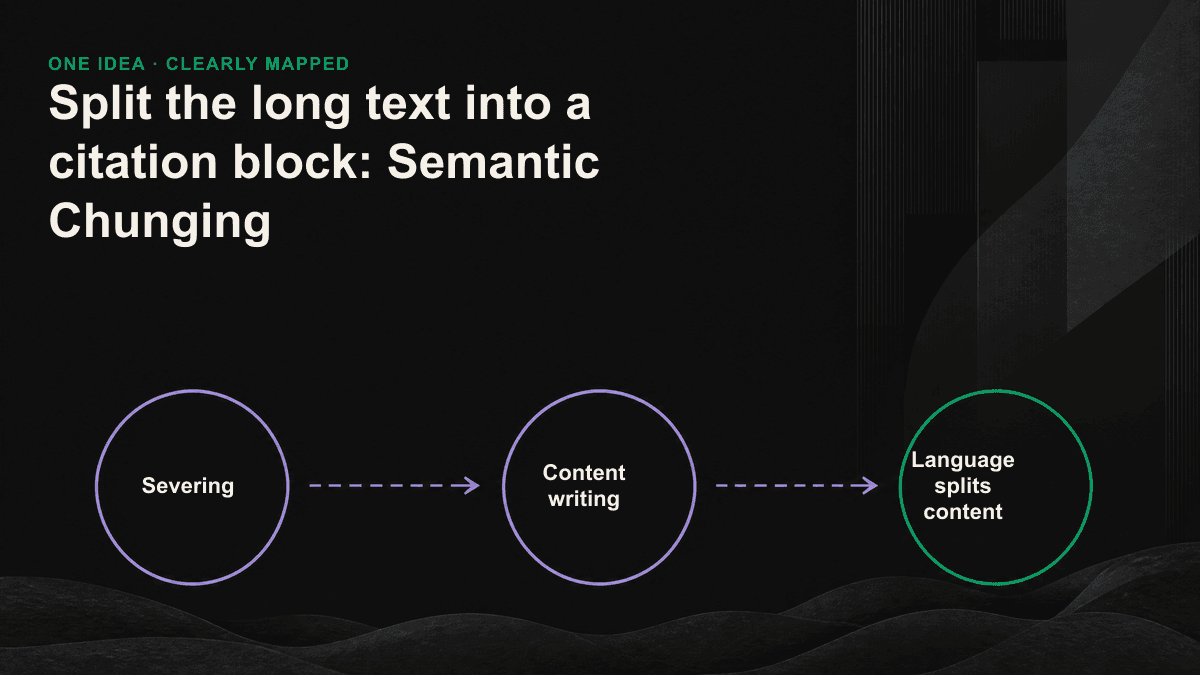
Semantic chunking was originally a technical term for the RAG system: cutting a document into a fully semantic piece, moving it into a vector database, and then searching for the most relevant pieces of data. What the writing side has to do is mirror the same thing. What you can do is to make your own article fit -- to make each part of it a full-fledged unit of language, not in context. It's a good-quality article, with models that don't end up without words, and that don't spell half the meaning to users.
Why is the block more important than the whole story?
When users ask a question in ChatGPT or Perplexity, the model does not stuff your entire article into the answer, but rather finds a small part of the question that can best be answered, rewrites the reply and attachments. This small paragraph usually has only one or three words. In your article, you have a couple of clean, independent paragraphs that largely determine how many opportunities you have to show yourself. It's a long article of logic, each of which leads to the previous text, which is well read, with little extraction of models, because it's half missing in any part.
- The first sentence begins with a conclusion or definition and does not have to wait to add
- The main word is clear.
- One thing only, narrow enough, complete enough.
- Bring a specific number, step or condition so that the model has something to draw on.
- It's on its own. Readers understand what it means.
Slice the pen instead of tearing it down later.
A lot of people write a smooth long paper and then look back at how to "a little bit." This is simply a way of cutting off successive narratives and filling each piece with proxies and cross-dependency. The more effective order is the reverse: decide which questions to answer and each paragraph to write. The boundaries of the paragraphs are determined by "a question, a full answer" rather than by the tone.
Invert from the question
First of all, there are eight to ten questions that readers really ask about the subject, such as "What's the difference between semantics and labels?" Each question contains a text that answers directly to it, and the first sentence of this paragraph is the answer, followed by two or three sentences to complement the text and examples. When you finish writing, you will find that the paragraph is naturally independent, because it exists to answer a single question. That's why the FAQ block is particularly easy to quote, and you're writing the whole article with the FAQ rule.
Three common ways to undermine citation.
The first one is the beginning of the suspense. The paragraph is laid at the end, and the model is drawn to the first half of the paragraph, which is empty, and the answer is mentioned in the first sentence and then opened. The second is cross-section. This paragraph goes on with the "situation of the above" and loses its subject once it is singled out, and the readers find it strange. The third one is a more important one, and the model does not know which sentence to cut, and often the whole paragraph is omitted; rather than one in two, one in three.
Length, format and internal structure
The quoted block does not have a hard number, but mostly between two or five sentences, about 60 or 120 words. Too short for a full answer, too long models will only take one sentence and the rest will be wasted. Format, define a category as "X is"... starts with a step-by-step list, compares the table with a column, and the number is placed at the beginning of the sentence. These structures are in themselves a signal to the model, telling it that there's an answer to move the whole piece.
The cursor is part of the cut. To be read as the answer to the question, the "three common ways to undermine citation" is better than "take care" because the former has predicted the content and scope of the lower block, and the model will be more accurate in setting up the response to paragraphs and themes.
How do you verify the quality of the whole section?
After writing, do two things. First, there's a few of the extracts that can stand on their own. That's the citation density of your article. Second, take the core questions of the article to ChatGPT, Perplexity, Google AI Overviews, and ask each other whether the paragraph you drew from the model's answer was the one you wanted to get. If it quotes others and omits you, it's not usually you who write worse, it's your answer that is not cut out to move. You want to know what you're missing in the AI engine, about 30 minutes for the GEO diagnostic session, and we'll run your page and run it for you.