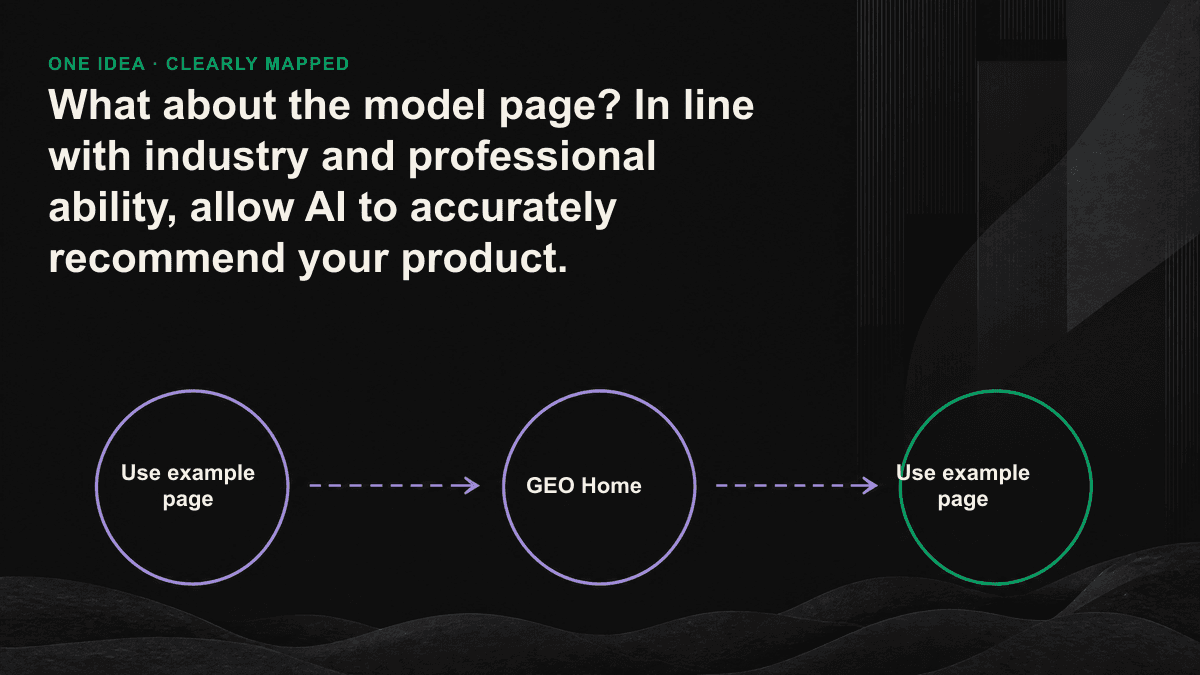
Using an example page to get an AI recommendation, the point is not how complete it is, but how small it is. The "product application scene" page of the page, with the AI engine only having a vague impression of being able to respond to any specific queryer. What is really going to be quoted is the "how the electricity company sells X as a reason for re-marketing" industry, which uses a functional page -- because the person who asks is also asking about his own business and position.
Why can't we get an AI quote from the generic model page?
When the generator answers the question, it does so in terms of language matching: the user's position, industry, role and intentions are the closest paragraphs to the contents. The page contains an example page entitled "Applications for all walks of life, groups and groups" , where the amount of interest falls on the middle ground, and where any query has a little bit of a problem and none is close enough, so neither of them is included in the source.
Tenten was the most common waste when the B2B SaaS client was doing the GEO audit: the customer had a good flow of the "Use Cases" page, but the specifics of the search for his family type on ChatGPT, Perplexity, were always cited as one page for the competition. The difference is not in the quality of the content, in the particle size.
Creates a model matrix with "Industrial X Functions"
Don't rush. Two axes are distributed: the axis is your target industry, and the axis is a function of actual decision making and practical use. Every one of the two axes that crosses out is the potential use of the page. This matrix solves two things at the same time -- it forces you to figure out what you're looking for and what you're looking for on every page.
- Product axis: ecommerce retailing, financial insurance, medical treatment, manufacturing, education, SaaS itself -- pick three or five of your customer's list for real deals, and don't fill it up.
- Caption: marketing, running, business, product, finance, IT - lists the roles that will pay for the issue and use the product every day.
- Cross-referenced example: "How Financial Sectors Auto-activate KYC Document Reviews": "How Managers of Manufacturing Industries use instant view boards to lower stoppages" -- each is a specific query that can be directly quoted.
Do not fill every cell in the matrix. Only six to eight of the 20 cells may represent real, high-value demand; leave the rest blank. Choosing what not to publish matters because it defines the situations you do not serve, and AI engines reward explicit boundaries.
The structure of the page with an example page
The particle size is right and each page is self-contained and clean. It's a part of the extract from the AI engine that doesn't put together information that's scattered around you. So it's better to write each page in a fixed skeleton so that the answer is in the paragraph where it should be.
- The beginning of the situation: "Who, in what situation, what to solve" in one sentence, so that the first section of the engine can be right."
- The situation is painful: what can this industry do today, why is it stuck, with specific processes, not adjectives?
- Solving step: Which steps are your product actually running in this scene?
- Quantifiable results: Time, cost, conversion improvements, and in real cases the client type.
- The question is often asked: respond to two or three of the questions the character most asked, so that the engine can be QA.
The advantage of this set of skeletons is that it can be replicated. After eight pages of the matrix, eight pages share the same set of structures, writing and reading faster, and the AI engine is more likely to judge what each page is talking about because of the same structure.
How do you decide which pages to make first?
Eight cells won't be finished at the same time. Three questions: is the combination of the industry and the ability to do so high in your transaction log? Who's been quoted on the AI engine? Do you have any real cases or numbers that can hold this page? The three were "yes" first, which was the starting point for the highest rate of reporting.
The details of the exact recommendation for AI
Once the particle size and structure are in place, there are a few details of the impact extraction. The page title is written directly as a sentence that the user will ask, rather than as a marketing sign; the text is used in the industry's actual art, not all of it is translated into a generic liner; the result paragraph is a full sentence, so the engine is pumped out without adding the main word. These are the prerequisites for getting a text off your website and getting into the AI answer.
There is one thing in common with what can be quoted: to take out any single paragraph, it is a complete, credible and responsive answer.— Tenten GEO Content Engine Executing Principles
Also remember to cross-link other working pages of the same industry and other working pages of the same job. It's a signal for engines: It helps models understand that you have a systematic depth in the industry, not just a page, rather than merely a guide for people.
From matrix to sustainable content engine
Use an example page is not a one-time project. The matrix will change as you enter into a business deal and as the market asks. The ideal approach is to treat it as a rolling list of updates: to see each season what scenes on AI visibility monitoring are visible, what new issues come out, and to supplement or rewrite the page so that it continues to meet real needs.
If you already have a popular page and you can't get an AI quote, the first step is to open it and see what kind of business and job matrix you're in, and which ones are really valuable. If you want to take a quick look at where your gap is, you can schedule a 30-minute GEO diagnostic session, and we'll use your own kind of practical inquiry to see who's being quoted and where you are.